 ultimate-guide
Natural Skincare Anti Aging Results: What to Expect
Table of Contents
- Natural Skincare Anti Aging Results: The Honest Picture
- Natural Anti-Aging Skincare Ingredients That Earn Their Place
- Natural Anti-Aging Skincare Results Timeline: Week by Week
- Building an Organic Anti-Aging Skincare Routine by Skin Type and Age
- Sun Protection: The Foundation of Any Anti-Aging Routine
- Natural Anti-Aging Skincare Fact vs Fiction
- Patch Testing, Irritation, and Ingredient Safety
- Conclusion
- Frequently Asked Questions
Last Updated: October 19, 2026
Natural Skincare Anti Aging Results: The Honest Picture
Natural skincare anti aging results are the visible changes in fine lines, firmness, tone, and texture that follow consistent use of plant-based formulas over weeks and months. At Nutra-Lift, we believe in realistic expectations: expect gradual improvement, not overnight transformation. Consistency and sun protection are key to seeing results.
Below, we break down what each ingredient class actually does, how the timeline really unfolds, and how to build a routine that fits your skin type instead of fighting it.
Natural Anti-Aging Skincare Ingredients That Earn Their Place
Not every botanical on a label deserves your money. A short list of well-studied natural ingredients does most of the heavy lifting, and the rest is largely texture and scent. The difference between a formula that works and one that just smells nice usually comes down to three things: whether the ingredient has a plausible mechanism, whether it is present at a meaningful concentration, and whether the formula keeps it stable long enough to reach your skin.
Antioxidants, Oils, and Actives Worth Knowing
- Vitamin C from plant sources (e.g., kakadu plum, camu camu, rosehip): supports brightening and helps defend against daily UV stress by neutralizing free radicals. L-ascorbic acid is the most studied form, but it is unstable in water and oxidizes quickly; plant-derived vitamin C is often gentler and more stable but less potent gram-for-gram. Look for opaque, air-restrictive packaging and a formula that is not visibly browned.
- Niacinamide (vitamin B3): strengthens the skin barrier, helps even tone over time, and is one of the few actives that is both well-studied and generally well-tolerated. Most research uses roughly 2-5%; higher percentages do not necessarily work better and can sting sensitive skin.
- Hyaluronic acid: holds water in the upper layers for plumper-looking skin. It is a humectant, not a collagen builder, it improves hydration and the look of fine lines caused by dryness, but it will not restructure skin on its own. In dry climates, apply it to damp skin and seal with an oil or cream so it does not draw moisture out.
- Rosehip oil: rich in linoleic and linolenic fatty acids that support moisture retention and barrier repair. It is an emollient, so it softens texture and reduces water loss rather than delivering a direct anti-aging active.
- Green tea extract (EGCG): a gentle antioxidant that suits reactive skin and may help calm redness. Concentration and stability vary widely between products.
- Marine algae: supports skin renewal and hydration; the evidence is mostly formulation-level rather than ingredient-level, so judge the finished product rather than the label claim.
- Bakuchiol: a plant-derived retinol alternative that has small but promising studies behind it. It appears gentler than retinol, but the evidence base is far thinner, treat it as a reasonable option for sensitive skin, not a proven equivalent.
Concentration, Formulation, and Compatibility Matter More Than the Label
A botanical listed on the back of the box tells you almost nothing on its own. Three practical rules separate useful formulas from marketing:
- Concentration is not automatically better. Niacinamide above roughly 5% and vitamin C above roughly 15-20% tend to increase irritation without a clear payoff for most people. A well-formulated 5% product often outperforms a harsh 20% one because you can actually use it consistently.
- Stability and packaging decide whether the active survives. Vitamin C, retinol alternatives, and many antioxidants degrade with light and air. Opaque pumps and airless bottles protect them; clear jars and droppers do not.
- Some combinations irritate sensitive skin. Layering vitamin C with strong acids, or introducing several actives in the same week, is a common cause of redness and breakouts. Introduce one new active at a time, spaced about a week apart, and keep a barrier-supporting moisturizer in the routine.
How Natural Ingredients Compare With Conventional Actives
Conventional actives such as retinoids and glycolic acid have decades of clinical data behind them. Natural alternatives often deliver gentler, slower results with fewer irritation episodes. That trade-off matters for sensitive or acne-prone skin, where a harsh active can trigger weeks of setback. Bakuchiol, for example, is a reasonable choice for someone who cannot tolerate retinol, but it should not be sold as an equal swap. Many find beneficial outcomes when pairing proven actives with barrier-supporting natural formulas.
The American Academy of Dermatology's guidance on anti-aging skincare is clear that sunscreen and proven actives do the most measurable work. Natural ingredients perform best when they support those fundamentals rather than replace them.
Natural Anti-Aging Skincare Results Timeline: Week by Week
Results from natural anti-aging skincare follow a predictable arc, and knowing it prevents the "this isn't working" quit at week three. Skin renews itself roughly every four weeks, so any honest timeline is measured in months, not days.
| Timeframe | What You May Notice | What's Happening |
|---|---|---|
| Weeks 1-2 | Softer texture, better hydration | Moisture barrier starts recovering |
| Weeks 3-4 | Brighter, more even tone | Antioxidants reduce dullness |
| Weeks 6-8 | Fine lines look softer | Collagen support builds gradually |
| Weeks 10-12 | Firmer feel, improved elasticity | Cumulative renewal becomes visible |
| Month 4+ | Maintained firmness and tone | Results hold with consistent use |
How to Tell Whether a Product Is Working
Take a photo in the same light on day one, week four, and week twelve. Compare texture and tone, not just wrinkles. A product that keeps your skin calm, hydrated, and bright is working even before lines soften. If irritation appears and persists beyond a few days, stop and reassess.
Building an Organic Anti-Aging Skincare Routine by Skin Type and Age
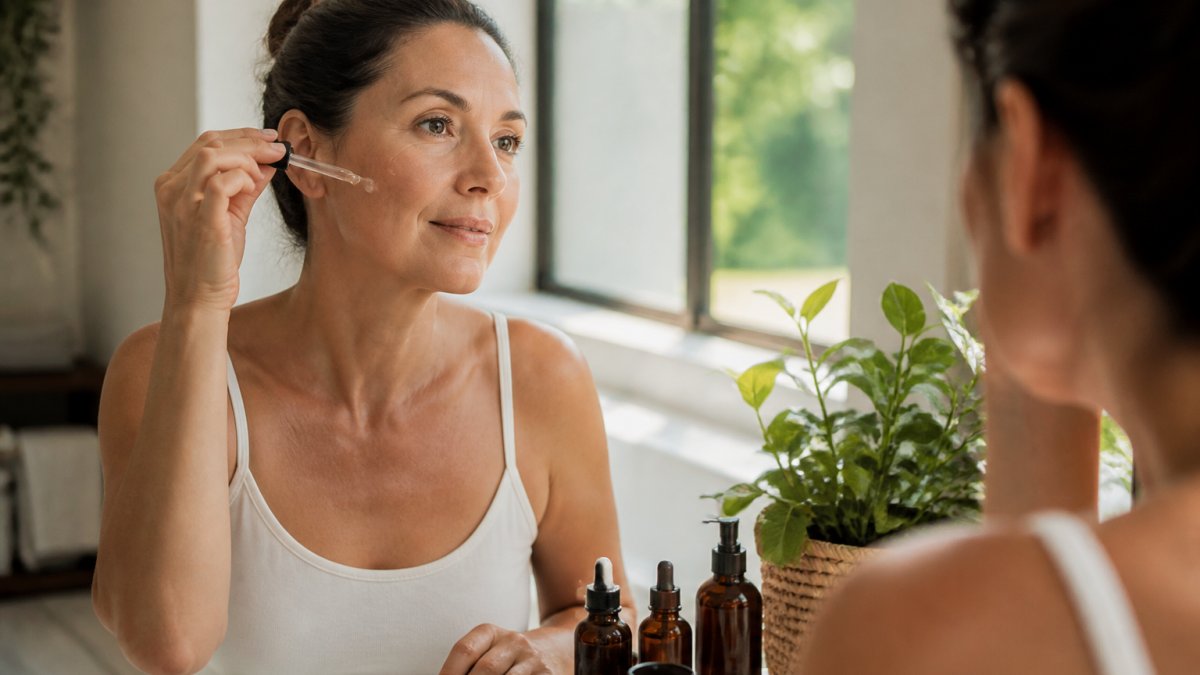
An organic anti-aging skincare routine works when it matches your skin type and your decade. In your thirties, focus on prevention: antioxidants, hydration, and daily sun protection. In your forties and fifties, add richer moisturizers and ingredients that support firmness and elasticity, since moisture retention declines with age.
Sensitive, Acne-Prone, and Combination Skin
Sensitive skin does best with fragrance-free, short ingredient lists and no physical exfoliation. Acne-prone skin benefits from non-comedogenic formulas and gentle chemical exfoliation once or twice a week. Combination skin usually needs two approaches: a lighter serum on the oily T-zone and a richer cream on dry cheeks. One well-formulated line can often cover both if the textures are light enough.
Sun Protection: The Foundation of Any Anti-Aging Routine
No ingredient outperforms daily sun protection. UV exposure is the single largest driver of photoaging, age spots, and crepiness, and it undoes much of what your serum is trying to build. The Skin Cancer Foundation's sun protection guidance recommends broad-spectrum SPF every day, not just at the beach. Apply it as the last step each morning, reapply during long outdoor stretches, and treat shade and hats as part of the routine rather than extras.
Natural Anti-Aging Skincare Fact vs Fiction
Separating natural anti-aging skincare fact from fiction saves money and disappointment. "Chemical-free" is marketing language, since water is a chemical. "Natural" is not regulated as a standard, so the label alone proves nothing. What does matter is formulation quality, ingredient concentration, and whether the product suits your skin. Patch testing, checking for non-comedogenic claims, and reading the full ingredient list tell you far more than a front-label promise. Before-and-after photos deserve skepticism too: lighting, angles, and filters can manufacture results that no cream could deliver.
Patch Testing, Irritation, and Ingredient Safety
Even plant-based formulas can cause reactions, and essential oils are a frequent culprit. Patch test on the inner forearm for 48 hours before a full-face trial. If you are pregnant or nursing, check with your clinician about which actives to avoid. Anyone with a history of allergies should introduce one new product at a time, spaced a week apart, so you can identify the cause of any reaction quickly.
Conclusion
The hardest part of natural skincare is patience: results arrive on the skin's schedule, not yours. Nutra-Lift makes that wait easier with over 80 spa-quality natural products, third-party verified formulas, and cruelty-free, non-comedogenic options built for sensitive and combination skin alike. Start with one product, test it properly, and protect your progress with daily SPF. Explore our categories and find the routine that fits your skin.
Frequently Asked Questions
How long does natural anti-aging skincare take to show results?
Most people notice better hydration and a smoother feel within 1 to 2 weeks. Fine lines and skin texture usually shift over 8 to 12 weeks, and uneven tone or dark spots can take 3 to 6 months because pigment changes happen deeper in the skin. The results timeline depends on ingredient concentrations, how consistently you apply products, and daily sun protection. Take a photo in the same light every two weeks so you can judge real change instead of guessing.
Which natural anti-aging skincare ingredients actually help with wrinkles?
Look for antioxidants such as vitamin E, green tea extract, and niacinamide, which help defend skin against daily UV and pollution stress. Hyaluronic acid and rosehip oil support hydration and moisture retention, which temporarily plumps the look of fine lines. Marine algae and plant extracts are common in firmness-focused formulas. None of these behave like a prescription retinoid, so expect gradual visible improvement in fine-line appearance rather than dramatic overnight change.
Can natural skincare improve dark spots and uneven skin tone?
Yes, with patience and sun protection. Brightening ingredients like niacinamide and vitamin E can help even out skin tone over several months, but UV exposure will undo progress faster than any cream can fix it. Age spots and hyperpigmentation from photoaging need daily broad-spectrum sunscreen alongside your brightening serum. If a product promises to fade dark spots in a week, treat that claim with suspicion.
Is natural skincare gentler for sensitive or acne-prone skin?
Not automatically. Essential oils and botanical extracts can still trigger irritation or breakouts, so check that a formula is non-comedogenic and patch test on your jawline for 48 to 72 hours before full use. Fragrance-free, short ingredient lists tend to suit reactive skin best. If your skin stings, flakes, or develops new bumps after starting a product, stop it and give your barrier a week to settle.
How can you tell whether a natural anti-aging product is working?
Track three things: how your skin feels a few hours after application, how makeup sits on your skin, and how fine lines look in consistent lighting. Take a baseline photo before you start, then repeat it every two to four weeks in the same spot and light. Visible improvement should be gradual and steady. If nothing changes after 12 weeks of consistent use, the formula likely isn't strong enough for your concern.
Can you reverse aging skin naturally?
You cannot reverse chronological aging, but you can improve how skin looks and behaves. Daily sun protection, consistent hydration, antioxidants, and gentle exfoliation reduce the visible effects of photoaging, which is the biggest driver of fine lines, crepiness, and age spots. Realistic goals are smoother texture, better moisture retention, and a more even tone. Anyone promising full reversal is overselling.